Investing — The Whole Return

Losing money can really make you angry, but, eventually, you can make up the losses. But when time is lost, you will never get it back. The factor of time in investment return calculations is limited to the time period of the investment, e.g. One Year, Year To Date, Trailing Three Years, Calendar Year, etc. Return calculations are objective and purely mathematical. The value of your time is left out of the calculation of investment return. What about the time you spend as an investor? What is it worth? Isnʼt that part of your whole return and shouldnʼt you include […] Read more »


Investing — Medically Speaking

Investing is like medicine. If you want to lose weight, any doctor can offer medically proven suggestions such as reducing calories and/or increasing exercise. If you want to grow your portfolio, over time, any professional can offer recommendations to help you by increasing your investments in the market and helping you remain invested when times are tough. But, neither doctors nor investment professionals can help everyone. Imagine a man telling his doctor he wants to lose 30 pounds without exercise and to include a dozen donuts per day in his weight loss plan. You can imagine the doctor’s response. It […] Read more »

An Idiots Guide to Investing

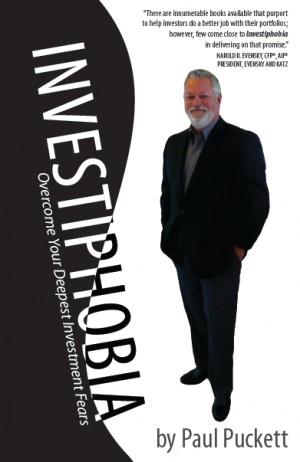
“You’re an idiot!” She said this to me in response to overhearing me discuss the theme of my book, Investiphobia: Overcome Your Deepest Investment Fears with a friend on the deck at Starbucks. At least she waited until my friend was gone to make her observation. So, I asked her why she believes I am an “idiot” and had a reasonable discussion despite her comment. Surprisingly, she based her conclusion on two observations she made relating to the purpose of my book and it’s message. She said if my purpose is to help people overcome and eliminate their fears, I’m […] Read more »

Lessons for Investors from Irene

Irene and a KFC Cup

Millions of Americans were affected by Irene, whether it was a hurricane or a tropical storm. The debate, for many, seems to center on whether reporters and forecasters “over-hyped” the strength of the storm as it approached the East Coast. The answers to that debate are not relevant but there is one lesson we can learn from the experience of forecasters as they plotted the probable track and strength of Irene. At a very basic level, there are two parts to forecasting hurricanes. The first is performed by computers and this generates a variety of possible tracks and levels of […] Read more »

Thinking About Joining the Gold Rush?

The latest Gold Rush made history yesterday when the SPDR Gold Shares ETF, Ticker GLD, passed the SPDR S&P 500 ETF in value. Both funds are managed by State Street Corp. As fearful investors sell stocks and invest heavily in the precious metal, GLD climbed to a total value of $77.5 billion to the SPY at $76.7 billion. The Wall Street Journal provided an excellent article yesterday “Gold Reigns even on the Stock Market”. What do you own when you buy gold? Read more »

Book Excerpt – Investiphobia: Overcome Your Deepest Investment Fears

The Fear of Thinking Long-Term “When you obsess over how your investment is doing from day-to-day or week-to-week, you could be more tempted to tinker with it instead of sticking to your long-term diversified plan. Not to mention, you’ll probably lose sleep.” Erin Burt, Kiplinger.com, March 13, 2008  “Asset allocation, not stock-picking, not sector funds, not guessing the direction of the Dow Jones averages, is the key to financial success.”   Jim Cramer, Intro to The Little Book that Saves Your Assets, by David Darst One of the most popular investment shows on TV is the Jim Cramer show, Mad […] Read more »

A Lost Decade, Really?

We’ve heard so much about the “lost decade” we may feel investing for the long-term is foolish. Numerous articles suggest the tried and true method of asset allocation is dead. “Buy Gold!” “Buy gold, guns, and two years worth of food” “Time the market” “Buy bonds, sell stocks!” But, did investors really lose a decade? Most people, particularly those working off debt, invest mainly in their 401k or other retirement plan. Few limit their investments to the Dow Jones Industrial Average (30 stocks), or the S&P 500, both representing large US based companies. The fund choices within a retirement plan […] Read more »